


A Shared Responsibility
Wildlife still moves freely across Zululand because individuals and companies, often far from the bushveld, choose to invest in conservation and in Southern Africa’s natural heritage. Most will never see these animals in the wild, yet their future is often influenced by decisions made in boardrooms, during strategy sessions, or on Zoom calls thousands of kilometres away.
The people around those tables may never stand on a dusty road at sunset and hear a lion’s roar roll across the plains or lie awake at midnight listening to the eerie whoop of a hyena and the rhythmic call of a fiery-necked nightjar. But they understand what those sounds mean and what it would mean if they were lost.
They understand what’s at stake.
Science Based Ingredients (SBI) understands the importance of protecting places like these. They believe in Wildlife ACT’s vision and place their trust in the teams on the ground, choosing to support not the spectacle but the steady, demanding effort that delivers lasting conservation impact.
Priority species and ecosystem conservation will always remain, well, a priority. But conservation today requires more than species-specific interventions. It needs a long-term, financially sustainable strategy that empowers and supports the people with boots on the ground and dust in their teeth to get the job done. And increasingly, it includes the adoption of technology and the development of the high-level technical skills required to use and sustain it effectively.
And that takes partnerships.
To the SBI team—we salute you.
My name is Quin Clark, Technical Project Manager for Wildlife ACT.
Where African Wild Dogs Still Run: A Story from Hluhluwe-iMfolozi Park
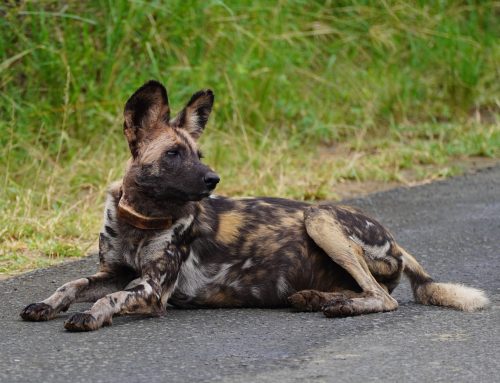
In the rolling hills of northern KwaZulu-Natal, long before the gates open to visitors and long after they close, something remarkable is happening. A pack of African wild dogs is moving through thick riverine bush and out on the red dirt roads. They are fast. Coordinated. Alert. Their mottled coats flicker through the bush like moving shadows. To see them in the wild is rare. To understand what it takes to keep them there is rarer still.
This is the story we’re beginning to tell.
A Landscape That Carries Weight
Hluhluwe-iMfolozi Park holds a special place in Africa’s conservation story. It’s widely recognised as the landscape that helped bring the Southern White Rhino back from the edge of extinction—a reminder of what long-term commitment can achieve. But rhinos are only part of the story.
The park is also home to one of Africa’s most endangered carnivores: the African wild dog (Lycaon pictus). Often called painted wolves for their striking, patchwork coats, they are among the continent’s most effective hunters. What makes them remarkable isn’t just their speed or skill; it’s their social bonds. They hunt as a unit, raise their pups together, and even care for injured pack members. Everything about their survival depends on cooperation.
Across much of Africa, their numbers remain fragile. Expanding human settlements, fragmented habitats, disease from domestic animals, and accidental snaring continue to put pressure on wild dog populations. In many places, they have disappeared entirely.
Here in Zululand, they are still part of the landscape. They still move through the bush at dawn. They still run.
Conservation Is Not a Moment – It’s a System
It’s easy to picture conservation as a series of dramatic moments — a collaring operation at sunrise, a helicopter lifting off for a relocation, a release into open bushveld. Those moments do happen, but they’re the exception rather than the rule.
Most conservation work is steady and deliberate. Some days it feels repetitive. Other days it’s physically exhausting. It’s rangers walking fence lines in 40-degree heat. It’s conservation teams checking camera traps and movement patterns again and again, looking for subtle shifts. It’s analysts working through large datasets, trying to spot trends that aren’t obvious at first glance. Its field monitors spending long hours in quiet bush, observing, recording and learning — often in isolation.
It’s tough work — relentless at times, sometimes painful, sometimes deeply saddening, and often seemingly thankless.
Yet the committed keep coming back. They return because they understand what’s at stake. They know how much of our remaining wilderness still depends on steady, consistent presence and that without it, the future of vulnerable species and the ecosystems they help anchor would quickly become uncertain.
Conservation means thinking beyond today, recognising that every decision made now shapes what survives tomorrow. And at its core, this work is about survival. This includes not only the survival of a species but also the ecosystem it depends on and helps hold together.
Why Private Support Matters More Than Ever
Across Africa, protected areas are facing a growing funding gap, often driven by shifting budget priorities and short-term decision-making. Government resources are stretched, and international funding is frequently tied to short project cycles with narrow scopes.
But wild dogs don’t operate in funding cycles.
Their movements aren’t dictated by financial year-end or quarterly reports. Protecting them takes consistency. It isn’t just about the headline moments — the new equipment, the relocation photos, the visible wins. It’s also about the quieter essentials: paying field staff, keeping vehicles fuelled, maintaining data systems, and covering the small, often overlooked needs that keep conservation running day after day. Not just moments of visibility, but long-term continuity.
Reliable, structured support gives conservation teams the confidence to plan ahead. It allows them to maintain and strengthen systems instead of constantly scrambling to patch gaps. And it shifts the focus back to what truly matters — delivering conservation outcomes, rather than managing uncertainty.
The Rise of Technology in Conservation
Over the past decade, technology has worked its way quietly into conservation. Not as a replacement for people on the ground — but as support. As reinforcement. Protected areas are vast, teams are often small, and budgets rarely stretch as far as they need to. Yet the responsibility hasn’t changed — protect wildlife, respond quickly, prevent loss. That pressure is constant, and increasingly, smarter systems are helping teams carry it.
Remote sensing devices, camera networks, and structured data platforms now give teams a much clearer view of the entire landscape. Wildlife movement, location and activity can be tracked more consistently, and subtle shifts that might once have gone unnoticed can be picked up earlier. Over time, patterns begin to emerge. Mapping tools and integrated databases bring those signals together, turning scattered pieces of information into something coherent. Conservation teams are increasingly able to anticipate and respond with greater confidence, moving from a reactive to a proactive state.
But technology does not replace bushcraft. Rangers still read tracks in the sand. Field teams still rely on instinct, experience and deep knowledge of the bush. The difference is that they now combine that bushcraft with better information. The landscape still demands skill — technology simply sharpens it.
The Bigger Picture
Wild dogs are often described as a “barometer species”. When a landscape is intact and functioning, they do well. When ecosystems begin to fragment and competition with humans begins to escalate, they are usually among the first to disappear.
Protecting them, therefore, goes far beyond protecting a single pack. It means keeping corridors open. It means maintaining fences and roads. It means reliable communication networks, monitoring systems that work, trained field teams on the ground, and strong relationships with neighbouring communities.
In other words, it’s about protecting systems — not just animals.
That way of thinking is increasingly shaping the future of conservation. The world is changing. Funding models are shifting. Technology is evolving quickly. But one thing hasn’t changed: conservation only works when it is sustained over time.
What This 12-Month Journey Will Share
Over the next year, we’ll open a window into what wild dog conservation actually looks like on the ground.
We’ll share:
- African wild dog/painted wolf as a priority species
- Hluhluwe-iMfolozi Park and its conservation significance
- Wildlife ACT’s embedded, on-the-ground conservation role within the park
- Science Based Ingredients × Wildlife ACT conservation partnership
- The growing role technology plays in modern conservation
- The increasing importance of private-sector investment in biodiversity protection
This will not be a highlight reel. It will be a grounded look at what it takes to keep one of Africa’s most remarkable predators moving freely across a living landscape.
Post Published Date: April 21, 2026